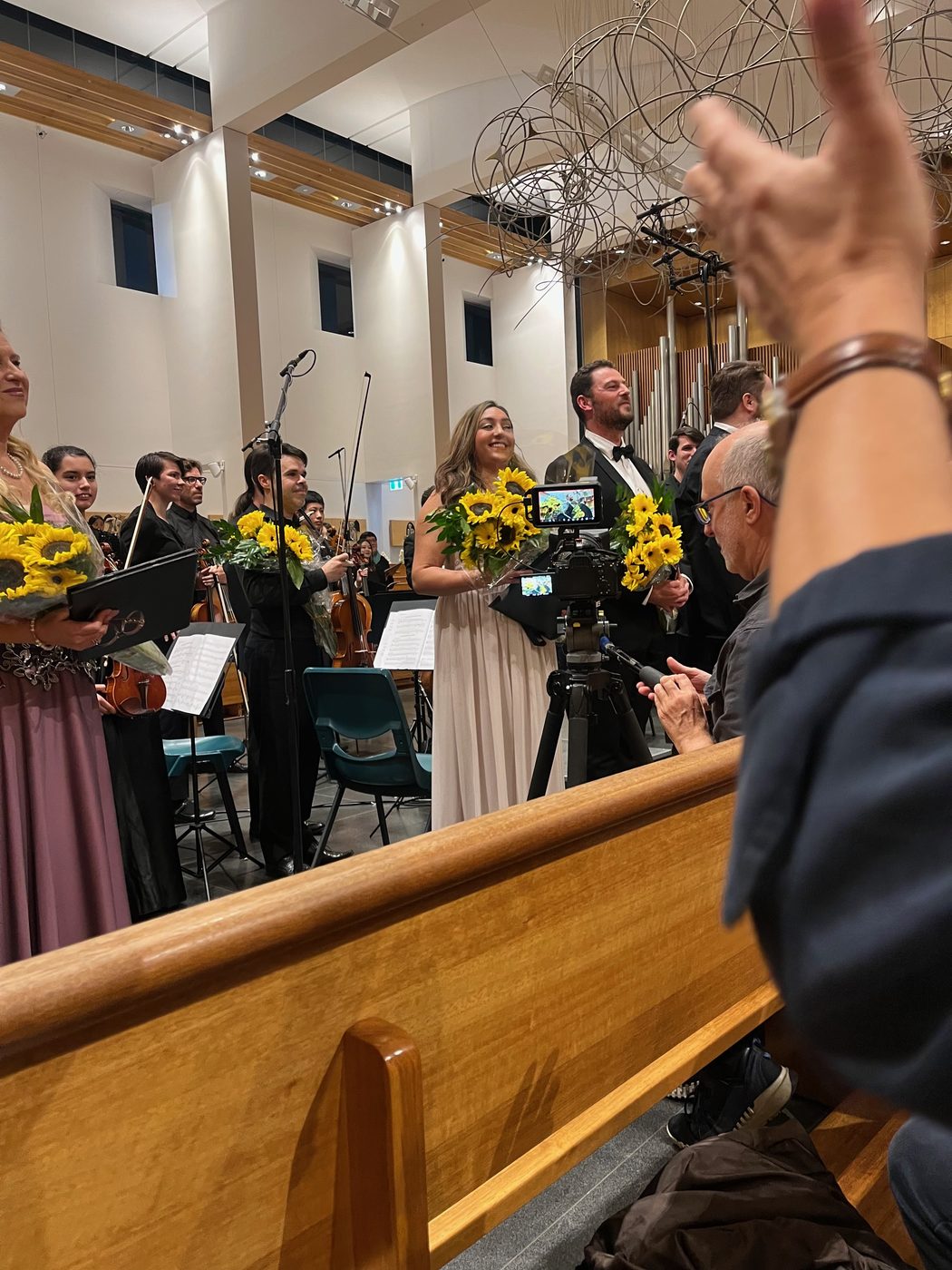
Some days you come home from a professional event feeling like you’ve vaguely ticked a box. Last Monday was not that. I came home from the Music in Me Summit energised in a way I did not quite expect, and I have been turning it over ever since.
The Summit is presented by the Australian Youth Orchestra and was held this year at ACO on the Pier in Sydney’s Walsh Bay Arts Precinct. Now in its third year, it brought together over 250 primary music educators for a full day of professional learning built around this year’s theme, Many Voices. One Classroom, a focus on diversity, inclusion and culturally responsive teaching. The program was genuinely varied: group singing, a neuroscience session, panel discussions, and more. I could not attend everything, and I was glad to hear it had all been recorded so I can catch up on what I missed.
The absolute highlight of the day was an In Conversation with Simone Young, hosted by ABC Classic presenter Genevieve Lang. I will be honest. I already knew who Simone Young was. I have been lucky enough to attend the Sydney Symphony Orchestra’s concert cycle of Der Ring des Nibelungen this year as an audience member, and it has been one of the genuine highlights of my year. Watching her conduct Wagner at that scale is something I will not forget in a hurry.
So, to then find myself sitting in a room with her talking to primary music educators, having, as she noted, essentially stepped off a plane, felt remarkable. Simone Young is internationally renowned and recognised as one of the great conductors of her generation. She was Artistic Director and General Music Director of the Hamburg State Opera and Hamburg Philharmonic for a decade. In 2024, she made history as the first woman ever to conduct Der Ring des Nibelungen at the Bayreuth Festival. She has stood on the great stages of the world. And she showed up to Walsh Bay on a Monday to talk to classroom teachers.
That means something.
What she said mattered even more. She spoke about her own education at a private school on Sydney’s Lower North Shore, and the music teachers who actively doubted her and put her abilities down. Coming from someone of her standing, it was not a comfortable thing to sit with. And the message she left us with has not left me:
Take care of the quiet ones in the class, because they are often the most capable, and they are the ones who need you most.
That connected directly to something raised in the earlier panel discussion on diversity. During audience questions, someone observed how frequently parents comment that they were told as children they could not sing, or express how grateful they are that their own child has been given the opportunity to learn music. It keeps coming up. A colleague confirmed they hear it constantly within their school community, and that it directly shapes how junior school performances and ensembles are structured.
The language we use around young singers and musicians carries further and longer than we realise. Paying attention to affirming language is not a small thing. It is the work.
The neuroscience session, led by Dr Anita Collins, educator, researcher, and the on-screen expert from the ABC documentary Don’t Stop the Music, was another highlight. She is an extraordinary communicator, translating complex brain research into something immediate and practical for classroom teachers.
Much of what she presented affirmed things I have already been trying to do in my own teaching. One example is normalising mistakes by separating the error from the child’s identity. Struggling with triplet rhythms does not mean a student is “bad at rhythm”; it simply means they have not mastered that skill yet.
Another idea that really resonated with me was her discussion of what she described as “art scars” — adults who carry the lasting effects of being told they were not musical, creative or artistic. We have all heard the phrases: “I can’t sing.” “I’m not artistic.” “I didn’t get into the choir.” Those experiences stay with people. They shape the way many parents view music education today. Some are incredibly grateful that their children have opportunities they never had, while others struggle to see the value because of their own negative experiences.
The research is becoming harder to ignore. The so-called Mozart Effect has evolved into something far more rigorous, and the evidence supporting music education continues to grow.
Simone Young also shared a story from her years in Germany. At her local school, teachers from mathematics and science would compete to be assigned to the music stream class, not because of the music itself, but because they knew those students came prepared in ways that crossed every subject: high-level preparation, the ability to focus, and the experience of working towards something collectively. Music was doing something the other subjects could not quite name, but absolutely noticed.
What struck me by the end of the day was that so many of the sessions arrived at the same conclusion from different directions. Simone Young spoke about the quiet child who is too easily overlooked. Dr Collins spoke about adults carrying the scars of careless comments made decades earlier. The panel discussed parents who still believe they “can’t sing”. Different speakers, different evidence, but the same responsibility: the words we choose as music teachers matter.
That, alongside the Kodály philosophy woven throughout the day, kept bringing me back to a quote shared early in the program:
“Often a single experience will open the young soul to music for a whole lifetime. This experience cannot be left to chance; it is the duty of the school to provide it.” — Zoltán Kodály
This was my first time attending the Music in Me Summit, and I hope it will not be my last. With the support of my school, I intend to keep coming back. Not just for the sessions or the speakers, though both were exceptional, but for what happens in the conversations in between.
Educators are stronger together. Critically reflecting on our programs, incorporating different perspectives, and being in a room with people who care as deeply about this work as you do, that is what keeps you moving forward.
The challenges in music education are real, and they are not going anywhere. But neither is the community of people committed to meeting them. Days like this remind me that I am part of that community, and that I have both the responsibility and the privilege of helping shape the way children see themselves as musicians.